 32:28
Why does e = 2.71828...? (Differential Equations 43)
26K views · 8d ago · 32:28
Why does e = 2.71828...? (Differential Equations 43) An exploration of the value of 'e', Euler's Number, using Euler's Method of numerical approximation.


This Channel is dedicated to quality mathematics education. It is absolutely FREE so Enjoy! Videos are organized in playlists and are course specific. If they have helped you, consider Support: You may find and support me at Patreon.com/Professorleonard Please consider "Whitelisting" this Channel on your AdBlock if it is enabled. Your support is GREATLY appreciated and is what helps fund more video creation. Thanks!!
Watched Professor Leonard? Tell other learners what you think below, or read the discussion around the channel.
32:2826K views · 8d ago · 32:28
Why does e = 2.71828...? (Differential Equations 43) An exploration of the value of 'e', Euler's Number, using Euler's Method of numerical approximation.
 59:37
31K views · 19d ago · 59:37
Using Euler's Method (Differential Equations 42) Exploring and understanding the use of Euler's Method to numerically approximate first order differential equations.
 56:31
48K views · 29d ago · 56:31
Introduction to Euler's Method (Differential Equations 41) An introduction to numerical methods of approximation for Differential Equations that cannot be solved explicitly or with traditional methods. Important foundation for further methods that are built around Euler's Method.
 1:27:04
42K views · 1mo ago · 1:27:04
Acceleration and Velocity with Resistance, Part 2 (Differential Equations 40) When Acceleration is proportional to the square of velocity. Also discussed is Hyperbolic Tangent inverse and how in the world we can use it here!
 1:29:39
40K views · 1mo ago · 1:29:39
Acceleration and Velocity with Resistance (Differential Equations 39) When Acceleration is proportional to velocity and inversely proportional to velocity.
 1:05:35
73K views · 2mo ago · 1:05:35
This is a technique that will make solving Bernoulli Equations MUCH easier by forcing them to be in the form of an Embedded Derivative. Enjoy!
 1:20
89K views · 2mo ago · 1:20
This is the first lesson in the Statistics Series I filmed for the Peterson Academy. I hope you like it! More content coming soon on my channel, for free as always.
 4:57
437K views · 2mo ago · 4:57
An Update from Professor Leonard about the future and exciting times ahead!
 4:17
387K views · 4y ago · 4:17
I thought I'd give you all an update about what's been going on!! Hope everyone of you is doing well :)
 46:38
155K views · 4y ago · 46:38
How to graph Polar Equations WITHOUT converting into Rectangular Equations by using symmetry of Polar Functions and plotting a limited number or points.
 24:48
57K views · 4y ago · 24:48
An introduction to graphing Polar Equations by converting them into Rectangular Equations and graphing them as conic sections or basic functions in the rectangular coordinate system.
 26:24
35K views · 4y ago · 26:24
How to convert equations from Polar form to Rectangular form using trigonometric identities.
 28:27
29K views · 4y ago · 28:27
How to convert equations from Rectangular form to Polar form using trigonometric identities.
 48:53
38K views · 4y ago · 48:53
How to use trigonometric relationships to change Rectangular Coordinate represented points into Polar Coordinate represented points including how to determine the correct quadrant for Tangent Inverse.
 34:24
43K views · 4y ago · 34:24
How to use trigonometric relationships to change Polar Coordinate represented points into Rectangular Coordinate represented points
 38:06
76K views · 4y ago · 38:06
What Polar Coordinates are, how to plot them, and why they are used in math.
 33:23
45K views · 4y ago · 33:23
A brief discussion of Simple Harmonic Motion, how it is related to Sine and Cosine, and the functional models it creates.
 16:19
45K views · 4y ago · 16:19
How to find the area of a triangle without explicitly knowing the height. The area formulas will find the area of a triangle if Side-Angle-Side or Side-Side-Side is known.
 56:36
34K views · 4y ago · 56:36
An Introduction into the Law of Cosines, how it is related to Pythagorean Theorem, and how to find missing sides and angles if Side-Angle-Side or Side-Side-Side is known in a triangle.
 1:27:46
41K views · 5y ago · 1:27:46
What the Law of Sines is, When it works, and how to use it to find missing sides and angles in oblique triangles.
 45:47
36K views · 5y ago · 45:47
Several examples of the Product to Sum and Sum to Product Formulas for Sine and Cosine that are used in Trigonometry. Proofs of the formulas are also demonstrated.
 1:20:34
53K views · 5y ago · 1:20:34
LOTS of examples of using the Double Angle and Half Angle formulas in Trigonometry.
 27:17
64K views · 5y ago · 27:17
The proofs of Double Angle Formulas and Half Angle Formulas for Sine, Cosine, and Tangent. These proofs help understand where these formulas come from, and will also help in developing future identities.
 58:07
35K views · 5y ago · 58:07
How to use the Sum and Difference Formulas to find angles in Trigonometry including Inverse Trig functions, Unit Circle applications, and proofs of phase shift identities for Sine and Cosine.
 51:27
62K views · 5y ago · 51:27
What the Sum and Difference formulas are for the three basic trig functions, where they come from, and how to use them to find exact solutions to angles that are not on the Unit Circle.
 42:46
31K views · 5y ago · 42:46
Guest: Right Triangle Trigonometry
How to find missing sides and angles of Right triangles using Right Triangle Trigonometry. Focus is on using the basic trig functions Sine (sin), Cosine (cos) and Tangent (tan).
 1:01:47
33K views · 5y ago · 1:01:47
What Sine, Cosine, Tangent and the reciprocal functions refer to in a Right Triangle and how to use them. Also discussed is the Co-Function relationships and the identities that come from them.
 55:39
85K views · 5y ago · 55:39
A very in-depth look at proving trigonometric identities. Several techniques are explored in many different examples of solving trig functions.
 23:44
89K views · 5y ago · 23:44
A quick look at Trig Identities and how to use them. Basic identities such as the Pythagorean Identity, Reciprocal Identities, and Even/Odd Identities are explored.
 1:34:36
101K views · 5y ago · 1:34:36
A very In-Depth look into solving equations that involve trig functions. We will focus on solving equations without having to use inverse trigonometric functions and relating solutions to the unit circle.
 1:18:27
41K views · 5y ago · 1:18:27
A very detailed explanation of Inverse Trigonometric Functions and how to use them in conjunction with Basic Trig Functions. Pretty much all you need to know about using inverse trig functions.
 7:14
32K views · 5y ago · 7:14
A very brief introduction to solving equations that involve inverse trigonometric functions.
 32:14
35K views · 5y ago · 32:14
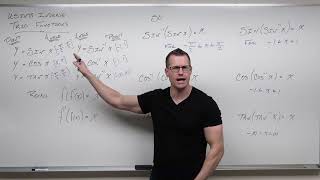
A step by step approach to find inverse trig functions along with their domain and range.
 53:55
56K views · 5y ago · 53:55
An in-depth look at how to use inverse trig functions and how they relate to basic trig functions. The domain and range of these functions is also thoroughly discussed.
 30:58
98K views · 5y ago · 30:58
What Inverse Trigonometric Functions are, where they come from, and why we need to restrict domain to be able to use them. Special focus will be on the nature of one-to-one functions and how they relate to the common trigonometric functions.
 37:52
45K views · 5y ago · 37:52
How to perform Horizontal shifts, called a Phase shift or Horizontal Translation, on trigonometric functions. While only Sine and Cosine are demonstrated, these techniques can be with all trig functions.
 29:55
31K views · 5y ago · 29:55
An introduction to the graphs of Secant and Cosecant by using their relationships with Cosine and Sine. Transformations are also explored and explained.
 40:39
34K views · 5y ago · 40:39
How to graph the Tangent function and the Cotangent function with transformations. Focus is on Vertical translation, amplitude, reflection, and manipulating the period.
 26:14
49K views · 5y ago · 26:14
The basics of graphing the Tangent and Cotangent functions, why the graphs look like they do, along with discussion of vertical asymptotes, intercepts, and key points.
 1:06:48
62K views · 5y ago · 1:06:48
How to Graph Sine and Cosine (sin and cos) along with all their transformations as easily as possible (Phase shifting, or horizontal translation, is a separate video).
 34:34
69K views · 5y ago · 34:34
The graphs of Sine and Cosine (sin and cos) and where they come from. Much of this video is focused on WHY the graphs look the way they do.
 37:54
49K views · 5y ago · 37:54
How to use Even, Odd, and Pythagorean Identities in trigonometry and where they come from. Special focus will be paid to the Unit Circle and corollaries of the typical Pythagorean Identities.
 46:54
47K views · 5y ago · 46:54
How the reciprocal identities in trigonometry work and how to use them. The major focus will be on connecting the ideas of a Unit circle with Right Triangle Trigonometry.
 1:10:54
81K views · 5y ago · 1:10:54
A discovery of the basic properties of Trigonometric Functions and why they work. Also, a technique for using the period of Trig Functions to simplify angles more than 2pi.
 42:57
90K views · 5y ago · 42:57
How to use the Unit Circle to evaluate Trigonometric Functions; Sine, Cosine, Tangent, Secant, Cosecant, and Cotangent.
 39:59
143K views · 5y ago · 39:59
The creation of the Unit Circle and how it relates to Right Triangle Trigonometry and the creation of Trigonometric Functions.
 36:57
56K views · 5y ago · 36:57
How to find the Area of a Sector, Arc Length on a great circle of a sphere, Angular Velocity, Rotational Velocity, and other applications.
 38:45
62K views · 5y ago · 38:45
How to convert from Radians to Degrees and Degrees to Radians. Focus will be on the development of the formulas and practicing the conversions.
Showing the 48 most recent videos. Everything plays right here on The Pod Atlas.
Have thoughts about Professor Leonard? Share them with other learners.
Write a review← Back to all educational channels