Tyler DeWitt

Tyler DeWitt

@tdewitt451 · 1.6M subscribers · 223 videos · English

Need help with Chemistry? Whether you're in high school, college, AP or IB courses, these videos can help! They are also targeted to students studying for the AP Test, SAT, MCAT, DAT, and OAT exams, as well as students in nursing, nutrition, pre-med and pre-vet programs. We'll cover the introductory topics patiently and clearly, using lots of examples, analogies and practice problems. The main topics covered in this library are: Significant Figures, Scientific Notation, Density, Stoichiometry, Nuclear Chemistry, VSEPR Theory, Atomic Structure, Covalent and Ionic Bonding, Thermochemistry, and G

What learners say

Watched Tyler DeWitt? Tell other learners what you think below, or read the discussion around the channel.

Click to see the discussion

Videos

7:10

Mole Fraction Introduction

85K views · 2y ago · 7:10

This video is an introduction to mole fraction. Mole fraction is one of the ways that we can describe or measure the concentration of different components in a mixture. It is calculated by dividing the moles of the component of interest by the total number of moles in the mixture. This video is for students in both high school and college/university.
11:51

Molarity: A Deeper Understanding

108K views · 2y ago · 11:51

Most students can work through the math formula for molarity (M), but they don't really understand what they're doing, or why they're doing. In many cases, students can't really explain what molarity is or what it means. Molarity is defined as moles per liter, and this information is very helpful actually understanding how to rearrange the equation, and solve problems in a way that makes sense.

10:21

Mole Fraction Practice Problems

45K views · 2y ago · 10:21

Here, we work through two practice problems involving mole fraction. Mole fraction is calculation that is used to determine the concentration of components in a mixture. The number of moles of a certain component is divided by the total number of moles in the mixture. When the numbers are not given in moles, you first have to convert from gams to moles by using the molar mass.

11:02

TEAS 7 Chemistry: Protons and Atomic Number

32K views · 3y ago · 11:02

For my full course on the Chemistry section for the ATI TEAS 7 This video is specifically for people who are preparing the ATI TEAS 7 exam. We cover all of the Chemistry that you'll need to know for the TEAS exam. Here, we talk about protons and atomic number, which are two very important things for understanding atoms. The number of protons or the atomic number determines the identity of the element.

17:32

AP Chemistry: How to Work Smarter, Not Harder

42K views · 3y ago · 17:32

Guest: AP Chemistry

For free AP® Chemistry resources AP Chemistry can be very challenging, but students often take the wrong approach. They take a brute force approach, give up hours of sleep, and practically cry blood. Instead, the AP Chemistry exam rewards students who take an approach that is "smarter, not harder." Students tend to do best on the AP Chemistry exam when the work to understand the concepts instead of just memorizing and when they can see the big picture.

17:18

TEAS 7 Chemistry: Introduction to Atoms

44K views · 3y ago · 17:18

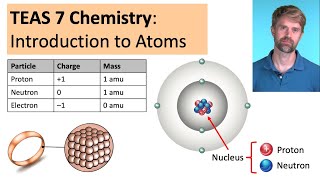
This is a video about atoms and atomic structure that is specifically for people who are taking the TEAS exam. We cover all of the relevant information that is most important for the TEAS 7 Chemistry section, such as atoms, elements, and subatomic particles (protons, neutrons, and electrons) along with their mass and charge.

51:23

Introduction to the AP Chemistry Multiple Choice Questions (MCQ's)

38K views · 3y ago · 51:23

Students often say that the multiple choice questions (MCQ's) are the hardest part of the AP Chemistry test. And they really are tricky. The MCQ's are different from the sort of multiple choice questions that show up on most other types of exams, and they test multiple concepts at the same time. They also require some math skills and puzzle solving. Here, we work through a bunch of AP Chemistry-style multiple choice questions (MCQ's).

Topics: Ionic Compounds and Formula Writing · Gases, STP, and Moles · Particle Diagrams: Physical Changes · Electron Configuration and Ionization Energy · Molarity and Dissociation · Mass Spectra and Atomic Mass

3:40

Ionization Energy and the Photoelectric Effect (AP Chemistry)

15K views · 3y ago · 3:40

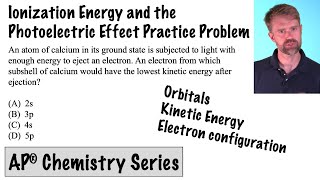
This is an AP Chemistry multiple choice question (MCQ) focusing on ionization energy and the photoelectric effect. During the photoelectron effect, a photo hits an atom and ejects an electron. Based on the kinetic energy of the electron, it possible to determine characteristics about the electron's location. The question also asks about electron orbitals, shielding, kinetic energy, ionization energy, and electric configuration.

4:08

Acid Conjugate Base Multiple Choice Question (AP Chemistry)

30K views · 3y ago · 4:08

Acids and conjugate bases classify compounds based on whether they accept or donor protons (H+ ions). Acids donate or give up a proton or H+ ion, and bases accept a proton of H+ ion. This classification is known as the Bronsted Lowry theory of acids and bases. Compounds can be classified as acids and conjugate bases, as well as bases and conjugate acids. Often, we need to identify the acid/conjugate base pairs, or the base/conjugate acid pairs.

4:50

Delta G, Delta H, and Delta S Problem (AP Chemistry)

17K views · 3y ago · 4:50

Delta G (Gibbs Free Energy), Delta H (Enthalpy), and Delta S (Entropy) define whether a reaction will be thermodynamically favorable or thermodynamically unfavorable. These terms are often also referred to as "spontaneous" or "non-spontaneous." This is a multiple choice question (MCQ) that is specifically designed to prepare for the AP Chemistry test, but may also be relevant for other exams and curricula such as A-levels, IGCSE, JEE, NEET, MCAT, DAT, OAT, GRE and SAT.

4:46

Entropy and Reactions Problem (AP Chemistry)

19K views · 3y ago · 4:46

This is an AP Chemistry-style multiple choice question (MCQ) focusing on entropy (delta S) and reactions. We have to determine which reaction illustrates the least increase in entropy. Entropy measures the amount of disorder in a system. In order to figure this problem out, we need to keep two essential entropy trends in mind: entropy increases as we transition from solid to liquid to gas. Entropy also increases when we create more moles of gas.

6:44

Dilutions and Lab Procedure (AP Chemistry)

12K views · 3y ago · 6:44

This AP Chemistry multiple choice question (MCQ) video focuses on dilutions and lab procedure. These are common topics on the AP Chemistry exam. First, you need to dilute a stock solution to produce a working solution. This requires using the dilution equation, M1V1 = M2V2. There are common mistakes that students often make, and the answer choices are designed to try to trick and trap you. Then, you need to be able to use proper laboratory procedure.

7:18

Kinetics and Reaction Rates (AP Chemistry)

19K views · 3y ago · 7:18

Here, we work through an AP Chemistry multiple choice question (MCQ) that focuses on kinetics and reaction rates. Specifically, we look at the method of initial rates, where we look at how the initial concentration of a reactant changes, and see what effect that has on the rate of the reaction. There are a number of different ways to solve a problem like this: we will look at a logic-based approach and then some more mathematical methods.

20:37

Solubility Curves and Practice Problems

218K views · 3y ago · 20:37

Here, we look at solubility curves. We see what they mean, how to read them, and how to answer questions using them. We begin with an overview of solutes, solvents, solutions, and solubility, and then look at general trends for solubility and temperature. Then, we look at the process for reading a solubility curve to determine solubilities and different temperatures, and vice versa.

5:33

Electroplating Calculations (AP Chemistry)

11K views · 3y ago · 5:33

This electrochemistry AP Chemistry multiple choice question (MCQ) uses dimensional analysis or conversion factors to determine the amount of time required to electroplate a certain amount of metal. Solving this requires understanding Faraday's constant and amperes, as well as knowing how to convert from grams to moles and how to determine the number of electrons in an oxidation reduction (or redox) reaction.

5:20

Intermolecular Forces and Boiling Point (AP Chemistry)

52K views · 3y ago · 5:20

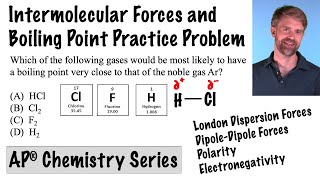
In this video, we look at an AP Chemistry multiple choice question (MCQ). We find a compound that has a boiling point similar to Argon. Boiling points are influenced by intermolecular forces or IMF's, so we need to figure out which of the answer choices has similar IMF's to Argon. Some of the key types of IMF's are hydrogen bonds, dipole--dipole attractions, and London dispersion forces. London dispersion forces are caused by the random movement of electrons.

12:45

States of Matter (Phases of Matter): Solids, Liquids, and Gases

236K views · 3y ago · 12:45

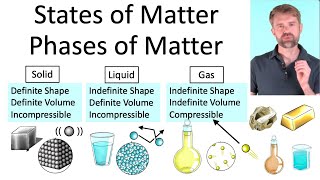
Here we'll talk about states of matter, also known as "phases of matter." They are solid, liquid, and gas. We won't be talking about exotic phases of matter like plasma. Matter is anything that takes up space and has mass. It's "stuff." We'll examine the unique characteristics of each phase or state of matter, and look at the particles that make them up. We'll look to see whether they have a definite or indefinite shape and volume.

9:30

Radioactive Decay Calculations Practice Problem

60K views · 4y ago · 9:30

Here, we'll work through a calculation involving radioactive decay. This type of problem involves variables including nuclear or radioactive half-life, decay constant (k), time elapsed (t), as well as natural log (ln) functions, and the number e. Questions of this type are commonly found involving unstable isotopes and radioactive dating.

22:43

AP® Chemistry: Bonding, Hybridization, Intermolecular Forces, Enthalpy

100K views · 4y ago · 22:43

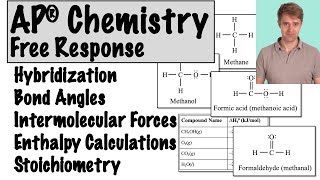
This video covers is an example for a long format free response question for the AP® Chemistry exam. It covers a variety of topics that include: Lewis Structures, Hybridization, Bond Angles, Intermolecular Forces, Hydrogen Bonding, Dipole-Dipole Interactions or Attractions, Boiling Point, Melting Point, Enthalpy of Formation Calculations, and Stoichiometry. The Lewis Structures include alkanes, alcohols, carboxylic acids, and aldehydes.

15:09

AP® Chemistry Kinetics Questions Free Response

39K views · 4y ago · 15:09

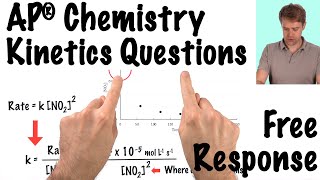
This video covers a variety of kinetics problems that are similar to those that would be on a free response section of the AP Chemistry exam. The topics include: reaction rate, reaction kinetics, order of reaction, and order of reactants. We discuss how to read reaction graphs and determine whether a reaction is zero order, first order, or second order. We see how to write rate laws and determine rate constants from initial rates and experimental data.

19:17

AP® Chemistry Weak Acid Equilibrium Questions

50K views · 4y ago · 19:17

Equilibrium questions are some of the most common problems to show up in the free response section of the AP Chemistry text. These weak acid equilibrium problems involve calculating the Ka or acid dissociation constant, and then completing an ICE table, to determine the initial, change, and equilibrium concentrations of the acid and the conjugate base. We then use the Henderson Hasselbalch equation to solve for the concentration of buffer components.

1:25:18

AP® Chemistry Multiple Choice Practice Problems

138K views · 4y ago · 1:25:18

These practice problems for AP® Chemistry will help you study for the test, and get a five! These multiple choice problems are written to be as close as possible to the real AP® Exam. They cover all of the usual topics: stoichiometry, gas laws, kinetics, equilibrium, acids and bases, thermodynamics, thermochemistry, electrochemistry, le chatter's principle, Gibbs free energy, entropy, and enthalpy. For each problem, we talk about the tips and tricks to solve it.

Topics: Question 1 · Question 2 · Question 3 · Question 4 · Question 5 · Question 6

15:17

Unsaturated, Saturated, and Supersaturated Solutions

288K views · 5y ago · 15:17

Solutions may be unsaturated, saturated, or supersaturated, depending on the amount of solute they contain. These categories depend on the solubility of the solute, or how much solute can dissolve in a certain amount of solvent. Solubility is dependent on temperature, and for most solid solutes, the solubility increases as temperature increases.

12:44

Colloids

335K views · 5y ago · 12:44

Colloids are a type of mixture that is in between a homogeneous solution and a heterogeneous suspension. They have particle sizes that are big enough to be visible, but the particles do not settle out over time. Colloids exhibit the Tyndall effect, and they scatter light. Also, colloids can't be separated by filtration. All colloids have a dispersed substance in a dispersion medium. Some common colloids are fog, smoke, foam, gels, and emulsion.

9:07

Pressure and Gas Solubility (Henry's Law)

136K views · 5y ago · 9:07

Here we look at pressure and solubility of a gas dissolved in liquid. This is a relationship referred to as Henry's law. In this case, the solute is a gas, and the solvent is a liquid, water. Henry's law states that there is a direct relationship between partial pressure and gas solubility. When the partial pressure of a gas on or above a liquid increases, the solubility of the gas in the liquid increases.

10:56

Temperature and Solubility: Solids and Gases

163K views · 5y ago · 10:56

We'll look at the relationship between temperature and solubility for solids and gases. How much of a solid or gas solute can dissolve in a certain amount of liquid solvent? We will see the pattern or trend. For solids dissolving in water, it is a generally direct relationship. Although there are some exceptions, as temperature increases, solubility increases as well. For gas dissolving in liquid, it is an inverse relationship: as temperature increases, solubility decreases.

14:07

Aqueous Solutions, Dissolving, and Solvation

238K views · 5y ago · 14:07

We talk about dissolving aqueous solutions, where water is the solvent. We'll look at the process of solvation, which is what happens during dissolving, when particles of solvent surround particles of solvent and carry them into solution. This process happens differently for coolant and ionic substance. Covalent substances separate out into molecules. Ionic compounds dissociate into individual ions, a process known as dissociation.

12:16

Solutions Overview and Types

389K views · 5y ago · 12:16

This is an overview of solutions or homogeneous mixtures, which have a uniform and even composition. They are different from heterogeneous mixtures or suspensions, which are not evenly mixed, and eventually settle out or separate out. Solutions are made of a solute and solvent. We'll look at liquid solutions with gases, solids, and liquids, and particularly aqueous solutions. We'll also look at solutions of gases, and solutions of solids, which are often metal alloys.

8:55

Tour of the Cell—Companion to Cellscape

98K views · 9y ago · 8:55

Learn about all the different parts of the cell, and how they interact. This is a 2D companion video to Cellscape. Tyler discusses the ribosome, mRNA, DNA, mitochondria, cell membrane, cytoskeleton, endoplasmic reticulum (ER), Golgi apparatus, microtubules, kinesin, tubulin, nucleus, nuclear pores, rough ER, smooth ER, translocon pores.

6:36

Cellscape VR Biology Guided Tour

368K views · 9y ago · 6:36

Journey inside the beautiful world of a human cell! Cellscape shrinks you down a couple million times, so that you can explore the inside of a human cell. See the parts of the cell, like the mitochondria, nucleus, ribosomes, RNA, endoplasmic reticulum, and Golgi apparatus.

3:24

Cellscape: The Story

49K views · 9y ago · 3:24

Cellscape, a virtual reality journey into a human cell, was developed by Tyler DeWitt and XVIVO Scientific Animation and was made possible by the Google Making and Science team. This is the story behind the project.

▶️ Mentioned videos: Cellscape

1:27

Exciting News: Virtual Reality Biology!

74K views · 9y ago · 1:27

Coming soon: an amazing 360o, 3D virtual reality experience inside the human cell. I really think this is going to change how we learn Biology. This video was funded by the Google Making and Science Team ( and I collaborated with an amazingly talented group at XVIVO Scientific Animation ( For the coolest experience, watch this with a VR headset, like Google Cardboard

10:00

Balancing Redox Equations in Basic Solution Example Problem

183K views · 11y ago · 10:00

A practice problem for how to balance an oxidation reduction (redox) reaction in basic solution. The process is similar to balance an oxidation reduction equation in acidic solution. Most importantly, both charges and atoms must balance. Here are the steps: first, calculate oxidations numbers for all the elements in the equation. Next, figure out what is being oxidized and what is being reduced. Then, write half reactions for the oxidation and reduction.

13:49

Limiting Reactant Practice Problem (Advanced)

891K views · 11y ago · 13:49

A limiting reactant problem where you have to convert back and forth between grams and moles. Limiting reactant or limiting reagent is the first reactant to run out in a chemical reaction, and it limits the amount of product you can make. In this advanced limiting reactant (limiting reagent) practice problem, we will learn how to solve for limiting reactant or limiting reagent when you are given grams of the reactants, and you have to convert to moles.

10:47

Limiting Reactant Practice Problem

1.4M views · 11y ago · 10:47

We'll practice limiting reactant and excess reactant by working through a problem. These are often also called limiting reagent and excess reagent. The limiting reactant or the limiting reagent is the first reactant to be used up during a chemical reaction. Once the limiting reactant or limiting reagent is used up, no more product can form.

16:58

Introduction to Limiting Reactant and Excess Reactant

3.2M views · 11y ago · 16:58

Limiting reactant is also called limiting reagent. The limiting reactant or limiting reagent is the first reactant to get used up in a chemical reaction. Once the limiting reactant or limiting reagent gets used up, the reaction has to stop and cannot continue. After the limiting reactant or limiting reagent is used up and the reaction stops, there is extra of the other reactants left over. Those are called the excess reactants.

15:55

Balance Redox Equations in Acid Example 2 (Advanced)

370K views · 11y ago · 15:55

We'll go step by step through how to balance an oxidation reduction (redox) reaction in acidic solution. This example is advanced. Most importantly, both charges and atoms must balance. Here are the steps: first, calculate oxidations numbers for all the elements in the equation. Next, figure out what is being oxidized and what is being reduced. Then, write half reactions for the oxidation and reduction.

12:23

Introduction to Balancing Chemical Equations

2.7M views · 11y ago · 12:23

How to balance chemical equations. We'll start out with examples that show the concepts behind balancing chemical equations. We will start with a word equation, and then write a chemical equations, and then visualize the atoms and molecules and how they change. To figure out if the equations is balanced, we look at the number and type of atoms on each side of the arrow. If the number and type of atom is not the same on both sides, the equation in unbalanced.

14:56

Balancing Chemical Equations Practice Problems

7.8M views · 11y ago · 14:56

Equation balancing will make sense! Here, we will do a bunch of practice problems for balancing chemical equations. We'll see the process or trial and error and the steps that you have to go through to balance chemical equations. You start by keeping track of the number of atoms on both sides of the equation, and then you add coefficients to one or more of the elements and compounds to make the number of atoms equal.

16:37

Introduction to Electrochemistry

2.2M views · 11y ago · 16:37

Everything you need to know about Electrochemistry. Electrochemistry is the relationship between electricity and chemical reactions. There are two ways that electricity and chemical reactions interact: certain chemical reactions can create electricity, and electricity can force certain chemical reactions to happen that wouldn't happen otherwise. We'll look at two very common examples in electrochemistry.

14:56

Oxidizing Agents and Reducing Agents

1.5M views · 11y ago · 14:56

We'll learn about oxidizing agents and reducing agents, what they are, what they do, and how to identify them in chemical equations. Oxidizing agents make oxidation happen, and reducing agents make oxidation happen. And oxidizing agent takes electrons from something, allowing it to be oxidized, and a reducing agents gives electrons to something, allowing it to be reduced.

23:35

Galvanic Cells (Voltaic Cells)

2.2M views · 11y ago · 23:35

All about Galvanic Cells, which are also called Voltaic Cells. These are devices that use a chemical reaction to create electricity. Moving electrons create electricity, and electrons flow from the anode, the site of oxidation, to the cathode, the site of reduction. The galvanic or voltaic cell also includes a salt bridge, which helps to balance charge, and lets ions move between the two half cells. In this video, we'll talk about oxidation, reduction, cathodes, and anodes.

12:33

The Immune System: B Cell, T Cell, Soldier, Spy

50K views · 11y ago · 12:33

In this fusion of storytelling and science, I talk about the immune system, explaining it from different points of view. I try to make this sort of like a spy novel, where you have to piece together the different parts. The immune system is an amazing thing that keeps us safe from pathogens. B Cells and T Cells fight off pathogens, many primary and second defenses try to keep pathogens out of our bodies in the first place.

8:46

Electroplating Part 2

224K views · 11y ago · 8:46

Here's well look at more details of electroplating. We'll talk about oxidation and reduction, anodes and cathodes. We'll write half reactions for the two processes that are happening in the electroplating cell. How does electroplating work? It is a process where you usually take an object made of one type of metal, and cover it with a thin layer of another type of metal. Usually, precious metals like gold, silver, or platinum are the metals that are electroplated.

32:46

Electrolysis

2.9M views · 11y ago · 32:46

Electrolysis is a process where you use electrical energy (electricity) to make a chemical reaction happen that wouldn't happen otherwise. Electrolysis is often used to break a chemical compound down into the elements that make it up. Here, we'll look at the electrolysis of water into hydrogen and oxygen, and the electrolysis of sodium chloride into sodium and chlorine.

Showing the 48 most recent videos. Everything plays right here on The Pod Atlas.

Have thoughts about Tyler DeWitt? Share them with other learners.

Write a review

More Chemistry educational channels

← Back to all educational channels