PT Pro Talk Podcast

PT Pro Talk Podcast

@ptprotalk · 17K subscribers · 1,299 videos · English

On this channel, you will find Physical Therapy related content, like interviews with experts that share their views and experiences, providing relevant info…

Episodes

5:36

Biofeedback Tools & Lower Extremity Strengthening for Dysautonomia

488 views · 4d ago · 5:36

In this discussion, we explore practical rehabilitation strategies, biofeedback techniques, breathing exercises, and lower extremity strengthening approaches that can support patients living with autonomic nervous system dysfunction.

Topics: Breathing Techniques for Autonomic Nervous System Regulation · Using Biofeedback to Improve Diaphragmatic Breathing · The Modified Dallas Program for POTS Rehabilitation · Individualizing Exercise Progression for Dysautonomia Patients · Managing Exercise Breaks and Patient Expectations · Gradual Exercise Progression and Horizontal Activities

▶️ Mentioned videos: to interview on YouTube

6:01

How Upper Respiratory COVID & Whiplash Inflame the Vagus Nerve

878 views · 1w ago · 6:01

In this discussion, we explore the potential relationship between vagus nerve inflammation, Postural Orthostatic Tachycardia Syndrome (POTS), dysautonomia, and the challenges patients may experience during recovery. The vagus nerve plays an important role in regulating the autonomic nervous system, helping control several essential functions throughout the body.

Topics: How COVID-19 Has Increased Autonomic Symptoms · Exercise Tolerance and Recognizing POTS · The Importance of POTS Diagnosis · COVID-19, Epstein-Barr Virus, and Vagus Nerve Inflammation · Vagus Nerve Function and Autonomic Nervous System Regulation · POTS, Gut Motility, and Mast Cell Activation

▶️ Mentioned videos: to interview on YouTube

1:15:59

Ep 217 - POTS for PTs: Subtypes, Vagus Nerve & Exercise with Dr. Jessica Workman

994 views · 1w ago · 1:15:59

Guest: Dr. Jessica Workman

In this episode of PT Pro Talk, host Arena Parks welcomes Dr. Jessica Workman, a physical therapist with 14 years of clinical experience and a Functional Manual Therapy Fellow, to discuss POTS from a physical therapy perspective.

Topics: Understanding POTS symptoms and diagnostic criteria · Different POTS subtypes and their characteristics · POTS, long COVID, hypermobility, and related conditions · The vagus nerve, autonomic nervous system, and manual therapy · Breathing mechanics, diaphragm function, and pelvic floor coordination · POTS exercise rehabilitation and the modified Dallas program

6:15

Passive Overpressure vs. Active ROM: Detecting Silent Hip Restrictions

891 views · 1w ago · 6:15

In this physical therapy case discussion, we explore how passive overpressure testing can reveal subtle hip mobility restrictions that a standard active range of motion (ROM) assessment may miss. Active range of motion testing evaluates how far a patient can move a joint independently using their own muscular effort. Passive range of motion testing involves the therapist moving the joint to evaluate its available movement.

Topics: Patient's Back Improves, but Knee Pain Persists · Reassessing Hip Range of Motion · Hip External Rotation Reproduces Pain · Internal Rotation Reduces Symptoms · Why Passive Overpressure Reveals Hidden Hip Restrictions · Recognizing the Hip's Role in Knee Pain

▶️ Mentioned videos: to interview on YouTube

8:09

Tennis Elbow… But Is It The Tendon?

938 views · 2w ago · 8:09

In this clinical case discussion, we explore a patient presenting with lateral elbow pain, initially diagnosed as tennis elbow, and discover why looking beyond the tendon can make a significant difference in assessment and treatment.

Topics: Tennis Elbow: Patient Case Introduction · Symptoms, Activities, and Functional Limitations · Assessing Elbow Range of Motion · Grip Strength and Resisted Supination Testing · Initial MDT Treatment With Elbow Extension · Adding Forearm Pronation to Elbow Flexion

▶️ Mentioned videos: to interview on YouTube

6:47

Spinal Stenosis… Or Something Else? An 80-Year-Old's MDT Case Study

1K views · 3w ago · 6:47

In this interesting clinical case study, we explore how careful assessment, clinical reasoning, and Mechanical Diagnosis and Therapy (MDT) helped uncover a possible alternative explanation for an 80-year-old woman's walking difficulties and persistent posterior thigh pain.

Topics: Walking Difficulties and Daily Activity Limitations · Questioning the Initial Spinal Stenosis Diagnosis · Persistent Thigh Pain and Symptom Assessment · Differentiating Neurogenic and Vascular Claudication · Lumbar Extension Testing and Clinical Findings · MDT Assessment and Repeated Lumbar Movements

▶️ Mentioned videos: to interview on YouTube

1:10:16

Ep 216 - 3 Wrong Diagnosis - How MDT Helped with Audrey Long

949 views · 3w ago · 1:10:16

Guest: Audrey Long

In this episode of PT Pro Talk Podcast, host Mariana Parks speaks with physical therapist Audrey Long about three clinical cases that demonstrate how Mechanical Diagnosis and Therapy (MDT) and careful clinical reasoning can help identify the actual source of a patient's symptoms.

Topics: How Clinical Reasoning Helps Identify the Real Cause of Pain · Case 1: Suspected Lumbar Spinal Stenosis · Using Hip Extension to Reassess Symptoms · Case 2: Knee Pain Mistaken for Runner’s Knee · How Hip Rotation Influences Knee Pain Assessment · Case 3: Elbow Pain Mistaken for Tennis Elbow

3:01

The Pain Plan: Automating and Personalizing Patient Education

1.1K views · 3w ago · 3:01

In this discussion, we explore The Pain Plan, an innovative approach to organizing pain science education resources and delivering them to patients through a structured, individualized learning schedule. Patient education is an important part of physical therapy and chronic pain rehabilitation. Patients often need more than a brief explanation during a clinical appointment to understand the complex mechanisms behind their symptoms.

Topics: Organizing educational materials by format and pain concepts · Personalizing resources for individual patients · Using automated calendars and QR codes for patient education · Introducing complex pain concepts gradually · Pilot testing The Pain Plan and future app development · Bite-sized learning and clear patient education plans

▶️ Mentioned videos: to interview on YouTube

5:34

Knee OA Isn’t Just About the Joint

1.1K views · 1mo ago · 5:34

In this video, we explore how widespread inflammation, physical activity, muscle strength, nutrition, mindset, and the nervous system may influence knee osteoarthritis symptoms and recovery. Knee osteoarthritis is a condition involving changes in the joint, but these changes do not explain every aspect of a person's pain. Inflammation and other factors can contribute to symptoms and influence how someone experiences movement and physical activity.

Topics: Why Knee Osteoarthritis Is More Than Just the Joint · How Exercise Can Improve Knee OA Symptoms · Understanding the Protectometer and Pain Science · DIMs and SIMs: Danger and Safety Signals · Changing Negative Beliefs About Knee Pain · How Clinicians Can Build Confidence in Movement

▶️ Mentioned videos: to interview on YouTube

45:27

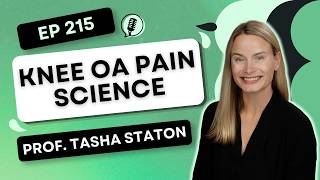
Ep 215 - Knee Osteoarthritis Pain Science: From Theory to the Clinic Room with Prof. Tasha Stanton

983 views · 1mo ago · 45:27

Guests: Prof. Tasha Stanton, Professor Tasha Stanton

In Episode 215 of PT Pro Talk, host Ariana Parks welcomes Professor Tasha Stanton, a leading researcher in clinical pain neuroscience at Adelaide University in Australia, to explore the science behind knee osteoarthritis pain and discuss how clinicians can translate research into practical, patient-centered care.

Topics: Why Bone-on-Bone Doesn't Always Mean Knee Pain · Inflammation, Exercise, and Pain Reduction · The Protectometer: Understanding Danger and Safety · Three Key Ingredients for Managing Knee Osteoarthritis · Delivering Effective Pain Neuroscience Education · OA Champions: Peer Support and Self-Management

Showing the 10 most recent episodes. Everything plays right here on The Pod Atlas.

Have thoughts about PT Pro Talk Podcast? Share them with other listeners.

Write a review

More Mental Health & Psychology podcasts

← Back to all pods