The Royal Institution

The Royal Institution

@theroyalinstitution · 1.8M subscribers · 1,947 videos · English

Explosive short films, full length talks from the world’s leading scientists and writers, and videos to challenge the way you look at the world. The Royal Institution is a 200 year old independent charity creating opportunities for the public and scientists to explore science together, through events, education, and the CHRISTMAS LECTURES. Become a YouTube Member to view exclusive Q&As and early release content: https://www.youtube.com/channel/UCYeF244yNGuFefuFKqxIAXw/join Or support us by donating: https://www.rigb.org/join-and-support/donate-ri We're part of the Amazon Associates programme,

What learners say

Watched The Royal Institution? Tell other learners what you think below, or read the discussion around the channel.

Click to see the discussion

Videos

1:01:38

Birds: The dinosaurs that forgot to die | with Steve Brusatte

4K views · today · 1:01:38

Guest: Steve Brusatte

Birds are dinosaurs. Not descended from them in some distant, diluted way, but living members of the same group, cousins of T. rex and Triceratops. In 1868, Thomas Henry Huxley stood in this very theatre and argued to a Victorian audience that birds had evolved from reptiles. His idea fell out of favour for decades, then returned with a dinosaur dug up in the Montana badlands, and was sealed by feathered fossils found by farmers in China.

Topics: Huxley’s 1868 lecture at the Ri · Huxley’s two-part proof: Archaeopteryx and Compsognathus · Ostrom, Deinonychus and the return of the dinosaur-bird link · Velociraptor: Jurassic Park vs reality · The feathered dinosaurs of Liaoning · Embryos, nests and the dinosaur inside every bird

▶️ Mentioned videos: Become a member to watch the exclusive Q&A session

58:58

The most abundant animal you’ve never seen | Tardigrades with Frank Ashwood

30K views · 7d ago · 58:58

Guest: Frank Ashwood

Soil is home to an estimated 59% of Earth’s species, and most of us never give it a thought. Soil ecologist and photographer Frank Ashwood takes us layer by layer through the living world beneath our feet.

Topics: What is soil actually made of? · Earth’s biggest biodiversity reserve · The layers of soil explained · Springtails and their self-cleaning skin · Hitchhiking mites and pseudoscorpions · Slime moulds and the Tokyo rail network

26:06

From the PhD Lab: How do biofilms help keep bacteria alive? - with Josh Horton

10K views · 9d ago · 26:06

Guest: Josh Horton

Microorganisms are constantly adapting to evade human-made interventions such as antibiotics and sanitisers. One of these adaptations is to use their strength in numbers and form a biofilm. One bacteria in particular forms biofilms that we encounter in many situations in our everyday life - salmonella. But what do we know about how salmonella forms this biofilm, so that we know how to eliminate it?

20:31

Why is quantum measurement so puzzling? | Puzzling Science with Maria Violaris

34K views · 11d ago · 20:31

Guest: Maria Violaris

Quantum mechanics is one of the most successful theories in physics... but what actually happens when we measure a quantum system? Quantum physicist Maria Violaris explores the measurement problem: one of the biggest questions and controversies in quantum mechanics. Starting with Schrödinger's famous cat, Maria explains how superposition and entanglement lead to a fundamental puzzle: if quantum systems can exist in multiple states, why do we only ever observe one outcome?

Topics: What is the measurement problem? · Schrödinger's cat · Many worlds or collapse? · The measurement postulate · Different theories of quantum mechanics · The many-worlds interpretation

1:35

Exploding pumpkins with acetylene #explosion #experiment #science #acetyline #halloween #sciencedemo

5K views · 12d ago · 1:35

It wouldn't be a holiday at the Ri without Demo Dan blowing something up in the lab! These calcium carbide explosions were used on a smaller, more controlled scale by miners in the 1900s - cool right? If you're keen to see more of Demo Dan's science experiments, the link at the bottom of the Short will take you to Dan's latest demo-filled episode filmed in the Ri theatre.

1:00:31

What comes after lithium-ion batteries? | with Saiful Islam
45K views · 14d ago · 1:00:31

Guest: Saiful Islam

Will your next phone, car or home battery still rely on lithium-ion? Materials chemist Prof Saiful Islam explores the batteries and solar cells driving the energy transition, from lithium-ion and sodium-ion to solid-state batteries and perovskite solar cells, with a few Ri style explosions along the way.

Topics: Why new materials matter for energy · Energy vs power: Faraday's candle and an explosive demo · Crystals, ion conduction and modelling materials with supercomputers · Lithium-ion batteries and the electric vehicle boom · Inside a lithium-ion battery: how lithium ions move · Future cathodes: lithium-rich materials and recycling

30:25

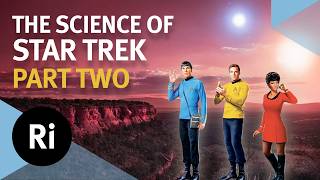
What Star Trek got right about science (and what it got wrong) | Part 2

26K views · 18d ago · 30:25

What would it actually take to become a Starfleet officer? How close are we to replicators, warp drive and futuristic medical technology? And what does real plasma have to do with a phaser? In Part 2 of The science of Star Trek, reserve astronaut Meganne Christian takes us inside real astronaut training and explores how today's space technology compares with the world of Star Trek.

Topics: ESA vs Starfleet: how astronauts train · Inside astronaut training · Spacewalks, microgravity and survival · 3D printing organs in space · Manufacturing, satellites and warp drive · The Royal Institution's Star Trek history

▶️ Mentioned videos: Video on youtube.com

1:42

How does caffeine work? #scienceexplained #sciencefacts #shorts

11K views · 20d ago · 1:42

Is caffeine part of your daily routine? Aarti Jagannath is an Associate Professor at the Nuffield Department of Clinical Neurosciences, University of Oxford. Having read for a DPhil on the mechanisms of RNA interference at Brasenose college, Oxford, she subsequently joined the Sleep and Circadian Neuroscience Institute as a Roche Post-Doctoral Fellow to work on the circadian clock and has stayed in the unit to become a group leader.

45:11

What Star Trek got right about science (and what it got wrong) | Part 1

60K views · 21d ago · 45:11

Celebrate 60 years of Star Trek with the real science behind the show: alien prosthetics, the search for life on Mars, whether the Vulcans could detect Earth, and why dilithium isn't quite fiction. Part 1 of 2. Jamie Gallagher hosts a night of scientists, engineers and superfans exploring where Star Trek got the science right, where it stretched the truth, and how the show has inspired real researchers and technology.

Topics: Welcome: Star Trek turns 60 · Why has Star Trek lasted 60 years? · Star Trek's tech predictions and the first mobile phone · Nichelle Nichols, NASA and saving the whales · Prosthetics: foam latex vs silicone (Leah SciFi) · Astrobiology: how do we search for alien life? (Joby Razzell Hollis)

▶️ Mentioned videos: Part 2

1:08:31

How maths reveals what your brain hides | with Kit Yates

84K views · 28d ago · 1:08:31

Guest: Kit Yates

Why do some people see a white and gold dress, while others see blue and black? And how can a coin flip help us uncover what people won’t admit to in a survey? Mathematician Kit Yates explores how our understanding of the world is shaped as much by missing information as by what’s there. Through illusions, live demos and gripping real-world stories, he introduces three types of “missingness”

Topics: Welcome: what is "missingness"? · Reading tests: how your brain fills in the gaps · Why perception isn't objective reality · Why a metal spoon feels colder than a wooden one · Sensory adaptation (and a deadly gas leak) · Inattentional blindness: the card trick

17:48

Can AI solve the hardest problems in mathematics? | PuzzlingScience with Yang-Hui He

135K views · 1mo ago · 17:48

Can AI help us solve some of the hardest problems in mathematics? In this episode of Puzzling Science, mathematical physicist Yang-Hui He explores how artificial intelligence is changing mathematical research. While attempting to solve a jigsaw puzzle with the help of AI, Yang discusses the rise of AI-assisted mathematics, why mathematicians need to verify AI-generated results, and how systems such as AlphaProof and Harmonic's Aristotle are approaching mathematical reasoning.

Topics: Can AI solve a jigsaw puzzle? · How AI is changing mathematics · AI tackles mathematical problems · The hardest problems in mathematics · Can mathematicians trust AI? · How AI verifies mathematical proofs

▶️ Mentioned videos: Video on youtube.com

1:04:02

We recreated Tesla's 1892 show | with David Ricketts & Michael Cutts

50K views · 1mo ago · 1:04:02

Guest: David Ricketts

Thank you for your patience whilst our team fixed the footage. Enjoy the show! Loud, crackling Tesla coils. Glowing plasma toroids. Beautifully strange Victorian discharge tubes. And, by the end, a full jazz duet played entirely in sparks.

Topics: Welcome and the First Spark · What Is a Spark? The Physics of Air · From Static Electricity to Faraday's Induction · Building a High-Voltage Transformer · Tesla's Breakthrough: Resonance · Jerry the Tesla Coil, and Tesla at the Ri in 1892

1:10:44

Do cells have goals? | with Melanie Challenger, Nick Lane & Philip Ball

83K views · 1mo ago · 1:10:44

Guest: Melanie Challenger

Is purpose something our brains invented, or is it built into life itself? Three thinkers take on one of science's oldest unresolved questions: what does it mean to be alive? Author Melanie Challenger is joined by biochemist Nick Lane and science writer Philip Ball for a live inquiry that begins with Richard Dawkins's claim that nature exists without purpose, and asks whether recent biology points somewhere different.

Topics: Does Nature Have Purpose? The Dawkins Challenge · Why Nobody Can Define Life · Building Life From Scratch, and Why AI Raises the Stakes · From Aristotle to "Man a Machine" · Energy Flow: What a Dead Whale Is Missing · Aristotle's Living Body and the Search for the Agent

42:45

The problem with de-extinction | with Sadiah Qureshi

23K views · 1mo ago · 42:45

Guest: Sadiah Qureshi

Traditionally, extinction has meant gone forever. But does it still? Historian of science Sadiah Qureshi traces how we came to believe in extinction at all (a surprisingly recent idea) and asks what happens to that idea now that biotechnology promises to reverse it.

Topics: When Nobody Believed in Extinction · Cuvier, Mammoths and the First Extinct Species · Neanderthals and the Discovery of Deep Human Time · How Extinction Shaped Colonial Prejudice · The Great Auk: Hunted for Its Rarity · Alfred Newton and the Birth of Wildlife Protection

📖 Mentioned book: Vanished: An Unnatural History of Extinction

▶️ Mentioned videos: Watch the Q&A

57:35

The Astronomer Royal on alien oceans | with Michele Dougherty

120K views · 2mo ago · 57:35

Guest: Michele Dougherty

Could there be oceans (and even life) hiding beneath the icy surfaces of the moons of Jupiter and Saturn? For most of the history of planetary science, the search for habitable worlds focused on planets close to the Sun, where surface water can stay liquid.

Topics: Inside the Cassini Spacecraft · How Scientists Measure a Magnetic Field · Saturn's Rings and a Mysterious Moon · Enceladus: Too Young to Be True · Cassini's First Flybys of Enceladus · The Gamble: Flying Closer

▶️ Mentioned videos: Video on youtube.com

Showing the 43 most recent videos. Everything plays right here on The Pod Atlas.

Have thoughts about The Royal Institution? Share them with other learners.

Write a review

More Science educational channels

← Back to all educational channels